Showing posts with label Loving More. Show all posts

Thursday, February 3, 2011

CPAA's letter to Loving More: an update on the polygamy law case in BC

Dear Loving More organization.

I am writing to update you on the progress of the Canadian
litigation. We would also like to express our support and gratitude
for the support of the Loving More organization and of the Polyamory
Leadership Network both at the conference in Seattle (where we made a
presentation on the litigation) and since then. We have had donations
since then of approximately $3000 toward the cost of the litigation
and when combined with the volunteer efforts and donations of our
volunteers, that money provides us with the ability to cover initial
costs and cover some of the costs of the likely, upcoming appeals

You will recall that the litigation is about s.293 Criminal Code of
Canada, a law which criminalizes polygamy but also makes it a criminal
offence to enter into any kind of conjugal union with more than one
person at the same time,whether or not it is by law recognized as a
binding form of marriage. It is also criminal to celebrate such a
relationship and it is not necessary to prove that sex is or was
intended to be a part of it. Although rarely prosecuted, the Attorney
General (AG) of the province of British Columbia, wished to use the
section to prosecute an insular, highly fundamentalist Mormon sect
(Bountiful) which practices patriarchal polygyny and against whom
there were concerns alleged about abusive behaviours, marriage to
underage girls, etc. The AG was given advice by prosecutors that the
law was unconstitutional and, under political pressure to address the
issues alleged at Bountiful, decided to ask the court a constitutional
reference question (essentially, for a judicial and highly persuasive
legal opinion) as to the constitutionality of the law. That question
is what this court case is about.

The parties to the litigation are the Attorneys General of Canada and
British Columbia (for s.293) and the Amicus (friend of the court,
appointed to argue against s.293). The court allowed Interested
Parties to come forward and 12 organizations originally did so,
including one of the Bountiful communities and various children and
women's rights organizations and civil liberties groups. The Canadian
Polyamory Advocacy Association (CPAA) was formed to become an
Interested Party and present a polyamorous point of view to the
court.

By November all the evidence was filed with the court. Five families
from across Canada have provided to the court affidavit telling about
their family situations for which they feared they would be viewed as
criminal given the wording of s. 293. The CPAA has also filed the
results of a survey, a 500 page Brandeis Brief of research and reports
respecting polyamory, and four books supportive of polyamory all of
which are intended to show the court that polyamory is not a "fringe"
movement and that is has something of value to offer to people and
society such that it should clearly not be criminalized in any way.

In November all the opening arguments were filed and on November 22
opening arguments were begun. The AG for Canada argued that the law is
legal and could be read to require that it only become illegal to live
together as a married couple if one had a ceremony to celebrate it.
The AG for BC argued the law was legal, but if it was not, then since
the governments could only show that there were harms to patriarchal
polygyny and could not show that there were harms to polyandry, then
it was legal only if someone lived in a configuration with one man and
more than one woman. Legal counsel for the CPAA, John Ince, presented
a brilliant opening argument pointing out the challenges of both of
these positions and suggesting that the AGs might have "lost their
moral compass" in trying to argue for the constitutionality of the
section on these grounds. The BC Civil Liberties Association
arguments aligned with those of the CPAA. Other organizations argued
for reading down the law to make it constitutional or to read in
elements of abuse, disparity of power, etc.

There has been no evidence presented which indicates there are harms
to polyamory and no one has asked to cross-examine the CPAA witnesses,
so CPAA has chosen to call no witnesses or present further evidence in
court. The CPAA position is that if no harms have been shown, then
the law should be ruled as unconstitutional vis a vis polyamorous
families.

Media attention has been wide, nationally and internationally. The
CPAA has declined requests during this busy trial preparation period
to be part of a documentary and has referred requests to the Loving
More organization, which has assisted documentarians and other media
people with finding polyamorous families and people who are willing to
be interviewed. Media media attention has recently been on
patriarchal polygyny and Bountiful since the parties and many of the
witnesses, both for and against s.293, are focused on arguing about
the harms of patriarchal polygny. Some women who are members of these
communities have been able to testify anonymously to protect them from
criminal prosecution and so the court could hear their testimony.
There are also social science witnesses who have testified about the
harms of patriarchal polgyny and how they view it possible that even
in a culture such as that of Canada, we will--if polygamy is
legalized--tend toward patriarchal polygyny resulting in more
unmarried men and increased violence.
The Amicus has been questioning these experts and witnesses.CPAA legal
counsel has been working closely with the Amicus throughout the trial.

The final witnesses will be called in February and there will also
shortly be a hearing on whether the CBC--Canada's national television
station--will be able to record and televise the closing arguments.
Closing arguments will be heard sometime in late March and early
April, 2011.

Those of us volunteering with the CPAA are now promoting the holding
of Polyamory Forums by polyamorists across Canada. Polyamorists in
Victoria, British Columbia, held a forum at the University in late
2010 which received a lot of media attention. We are hoping to host
one in Vancouver shortly after the closing arguments are heard so as
to focus public attention at that time on polyamory. There may also
be one on the East Coast. We also intend to promote the Polyamory
House Party weekend.

CPAA webpage: http://polyadvocacy.ca
A blog of the proceedings: http://dearpollyamorie.blogspot.com/
Court documents and certified transcripts (caution: note that there is
a publication ban on some of the witness' statements):
https://docs.google.com/?tab=mo&authuser=0&pli=1#folders/folder.0.0B-URIT52yhx4MDVkMDU5MDctZDM0Zi00ODQ4LWJkNWEtMWVjNmRjMGE2ZjQ0

It was a pleasure to meet up with you all at the Loving More
Conference and we hope to continue our alliance and friendship in
pursuing our mutual advocacy efforts.

Carole Chanteuse
CPAA

Monday, November 22, 2010

Loving More workshop: Facing a Monogamous World

This is the last installment of workshop reviews from the Loving More Poly Living conference in Seattle, 2010, that I attended. I feel like I was saving up writing about this one for reasons which didn't really become clear to me until I woke up this morning to read a poly friend's blog post which was answering what amounted to a hate-letter from a monogamous-identified woman who obviously felt very threatened by the very idea of polyamory.


Mixed in with my disappointment and anger at the attack was the feeling, for me, that there is still a long way to go in educating the mainstream population about not just polyamory, but about basic human rights and decency (I'll leave out the desire to see better grammar, though as an English teacher lack of punctuation does tend to colour my opinion of the person doing the writing).


Anyway, this is all a rather personal preamble to my review of a very stimulating and inspiring workshop presented by Pepper Mint, a San Francisco educator, organizer, activist, and social theorist in the polyamory and BDSM movements.  Pepper's contribution to polyamory includes advocacy and organization of local poly events in San Francisco, as well as his excellent blog,  Freaksexual.


His workshop offering at the conference centred on an interactive discussion brainstorming ways in which living in a mono-centric world affects our lives as polyamorous people. 


The workshop's opening statement:  "Most of the problems we face being non-monogamous come from living in a monogamous world" pulled no punches.  We are in a misunderstood (and often ignored) minority.  Not only are there cultural biases (and institutionalized ones) against polyamorous relationships, these biases create power imbalances which perpetuate the feeling of being different (or even persecuted) if you choose to have more than one partner.  


Pepper also reminded us that not all biases come from without -- we ourselves, as products of a monogamous social paradigm -- have embedded and unconscious assumptions about possessiveness, territoriality and competition within relationships that require us to do a lot of extra emotional work to be comfortable with our own poly desires.  


Finally, there is the phenomenon of expectations and even "etiquette" that is created within the sub-culture of polyamorous communities themselves.  We need to remind ourselves that simply because we enjoy the company of other poly people because they make us feel included within the context of a larger mono-centric world, there is no poly "rule book" or "one true way" to be polyamorous, though you often wonder reading poly forums and faq's referring to poly "definitions" and practices.  


I enjoyed the honesty and tough issues that were brought up in this workshop; it's not an easy thing, especially in an environment where you're feeling safe and accepted among your poly peers, to admit that it's a big, often cold and sceptical monogamous world out there that for the most part isn't terribly interested in people doing anything different from the norm.  To be poly in a monogamous world is to be different, and it's up to each of us to choose whether we want to hide, or advocate for change.  Either choice involves hard work and a certain amount of courage.  


Cunning Minx and Pepper Mint at Poly Living, 2010.


Friday, November 5, 2010

Loving More workshop: Poly Dating 101

I was really looking forward to attending Poly Dating 101, offered by Cunning Minx (the host of Polyamory Weekly).  Being the tech-savvy lady that she is (ok, she's a self-proclaimed geek), Minx has provided us with her superb slideshow on the blog, here.  This makes my job a lot easier, as I can just highlight what I enjoyed most about the workshop.

The basic premise of the workshop was creating strategies to figure out our own dating needs and how to present them to potential partners.  This twofold goal of "know thyself" and "communicate effectively" was niftily packaged in what Minx calls her "User's Manual", which is exactly what it sounds like.  She encouraged us to write our own manuals, both for the purpose of self-exploration and to give to other people so they know what makes us tick.

Starting with basics such as family history, values and even (or maybe especially!) personal baggage, our user manual should also include sexual preferences and relationship goals.  "You don't want to lose a relationship because you don't know what you want," says Minx, because "only you know what will make you happy."

My favourite part of the workshop, however, was our lively discussion of how to enter into an existing relationship as a "secondary" partner.  Her assertion that we are all "second to none" when it comes to relationships made me sit a little higher in my chair, since I am currently in several relationships with people who already have primary partners.

I really loved the intelligent interactiveness of this workshop; many of the participants brought their own insights and wisdom to the collective poly table, and I left feeling lucky that I have chosen to conduct my relationships within a community that understands and honours individual feelings and each unique connection.

I want to thank Cunning Minx for her hard work in bringing information, laughter and a whole lot of sexiness to what could be seen as a daunting process -- dating polyamorously.


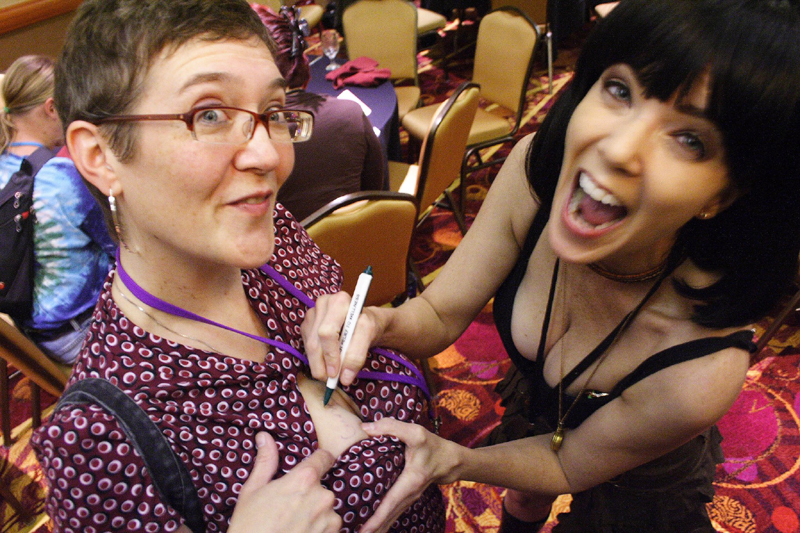
Cunning Minx autographs my User's Manual at the Poly Living Conference..

Thursday, October 28, 2010

Dossie on Jealousy: a synopsis of her Poly Living Workshop, 2010

One of the reasons I (and several of my friends) wanted to attend the Poly Living Conference this month was the opportunity to meet and listen to the co-author of The Ethical Slut, Dossie Easton. Practically every person who explores the history and literature of polyamory has read this book, and whether or not we think of ourselves as sluts, pretty much all of us try to adhere to the ethics of open, honest relationships that bring our partners as much pleasure as they do ourselves.

Much of what Dossie has to say in her work as a writer and therapist revolves around the idea that we are not born "perfect" at what we do -- anything, even learning to love, takes work and awareness. I loved how she spoke directly and with humility about her own experiences, mistakes and challenges. Dossie definitely gets across the message that love and sex are experiences within the human realm, and therefore subject to all kinds of difficult (as well as blissful) feelings.

I decided at the last minute to attend her workshop on "Making Friends with Jealousy". After all, I've been attending and leading poly discussions on this topic for many years, not to mention wrestled with my own jealous demons over the course of my poly life -- what could possibly be said that I didn't already know? Turns out I was glad I went.

I've been feeling very scientific lately, so when Dossie announced that she was going to focus on the physiology of jealousy, I perked up. So many people try to find deeply buried emotional reasons for jealousy (and for love, and attachments in general) that coming at this most complex and frightening of emotions from the perspective of our biological self seemed somehow comforting --like maybe jealousy is something I don't need to feel so guilty about experiencing.

Dossie introduced us to our amygdala: essentially the region in our brain where emotions are experienced. There have been, she said, great advances in brain research regarding the physiological components of emotional experience via hormones (such as the stress hormone, hydrocortisone, which is produced by our adrenal glands in response to stressful situations -- essentially, our fight or flight mechanism).


So, in terms of the experience of jealousy, there is a lot going on that is autonomic, or that our bodies are doing without our even realizing it, and this affects our perception of the situation. Dossie listed several things we can do, however, to mitigate the effect of our very human reaction to what we perceive as a dangerous situation (eg. when we feel jealous):

1. Take care of yourself. Schedule times for gratification and things you love doing but don't otherwise get the chance to do. If you can do these things when your partner is out on a hot date with someone else, so much the better!

2. Create a container for your jealous emotions so that you can experience them but not allow them to spill over and affect all aspects of your life and interactions. We get in trouble, she says, when we pretend not to feel something we are actually feeling. (Dossie herself cheerfully admits that she still gets jealous, but after 40 years of working on it, "it's sort of a non-event".)

3. Because we can't solve conflicts in a state of stress, taking at least 15 minutes to calm down (through breathing, meditation, or visualization -- or, depending on personal preference, gentle exercise) will actually "reset" our amygdala and increase our capacity to calm down the next time we get stressed. I thought this was pretty cool, and it also explains why handling jealousy does get easier the longer you address it.

4. Use distraction to deflect the cyclic process of negative thought patterns. This doesn't always work, but it can be an effective tool to derail some of the negative self-esteem chatter than crops up in our minds when we're feeling like we might lose someone's love or attention.

5. Release and banish the "shoulds". There is no one "right" way to feel. Just let your feelings be what they are (this is what she means by "making friends with your jealousy"). At this point in the workshop, Dossie took us through some breathing exercises and a short guided meditation/visualization of what our own jealousy looked like. We were encouraged to try and open a dialogue with our jealousy in whatever form we envisioned it and afterwards we shared this experience with others in the room. (I liked this exercise a lot, because it reminded me of one in my Buddhist practice called: "befriending your demons".)

6. Finally, she reminded us to focus on what we can control in our lives, and to practice letting go of what we can't. As poly people, we know that we cannot (and should not try to) ever, ever control our partners' feelings. We can, however, feel pretty confident that we can control our own feelings with the help of some relatively simple tools and the knowledge that sometimes, managing scary feelings is as easy as shutting off the hormonal hot-water tap and allowing ourselves to rest.

My thanks to Dossie for leaving us with the assurance that we are all beautiful human beings who have valuable things to contribute in terms of wisdom and love.

Wednesday, October 27, 2010

Canadian Polyamory Advocacy Association at Loving More's Poly Living


The CPAA at Loving More Conference!

Oct 26th, 2010 

We are back home–inspired, very grateful and exhausted!  The CPAA  attended the American Poly Living 2010 conference in Seattle (organized by Loving More, the leading national polyamory organization in the US) .  And not only did we attend lots of great workshops, but Zoe and I (Carole) presented a workshop on our Canadian court case!  (here at http://www.slideshare.net/polychickbc/cpaa-presentation10-23-2010).   

Read more of this blog post on the CPAA's site, here...

Tuesday, October 26, 2010

Loving More workshop: Who needs a safer sex elevator speech? YOU do!!

"If someone asks what your safer-sex protocols are, can you answer in two minutes or less?"

Reid Mihalko's workshop: "Creating Your Safer Sex Elevator Speech" tells you just how to do it. Intriguing twist on that oh-so-necessary poly conversation, no? I thought so, which is why I decided to attend this workshop.

I have to confess that I managed to be late for this one, due to the fact that the friend I attended the conference with and myself were staying across town at my lover's home. I'm lucky to have a wonderful partner in Seattle, but I forget sometimes that driving across the city early in the morning (especially a foreign city) takes a bit of extra time. Oops. Anyway, breakfast was delicious and the portion of the workshop I did manage to see was great, especially the group exercise at the end.

Reid, by the way, is an engaging presenter, well-accustomed to talking about sex. He's a polyamorous sex coach, counsellor and spokesperson for healthy relationship choices. His website, reidaboutsex.com, is packed with great advice and links and I recommend checking it out.

Back to the elevator speech. Reid pointed out that it's important to cultivate self knowledge before figuring out what to tell someone else about your safer sex preferences. Sounds familiar, right? It's also sort of difficult, as I found when I tried to write my own speech. To begin with, figuring out what your physical needs are should be balanced with what your emotional needs are regarding sex. Do you feel you just can't live without a fluid bond with an intimate partner? Make sure you say this, so your partner knows that condoms and testing will be mandatory with their other partners. Do you find latex sexy? Do you find condoms awkward for oral? There are many ways to work out a balance between people if you can actually start with your basic needs.

The other really important question we need to ask ourselves is: "What are you ok with getting?" Some STI's are not life threatening, but they may impose a social stigma on the person who carries the infection (HSV is one example). Since NO form of partnered sex (except maybe for web camming and mutual masturbation across the room from each other) is 100% safe, we use the term safer sex because we need to recognise as responsible adults that we are taking a risk. It's up to each of us to decide what our risk limits are and to express them clearly to our potential partners.

If this all sounds rather unsexy, Reid points out that it doesn't have to be. On the contrary, he's honed his matter-of-fact elevator speech to the point where it can actually be used as a great conversation opener at poly conventions and nightclubs. Another benefit to opening a safer sex conversation with a potential partner is that you get to see their reaction to the topic. If they seem uncomfortable or awed by your amazing sense of planning and forethought, you might want to reconsider sleeping with them, since they probably don't think much about testing or safer sex themselves. If, however, they respond with aware enthusiasm and offer their own list of requirements, it's a good bet they've given safer sex some serious thought and you're good to go!

We were then asked to write our own speeches, composed of how we describe ourselves (eg. poly, queer, kinky librarian), when we last got tested, what we were tested for and the results, our safer sex needs (eg. condoms for PIV and anal sex but not oral, disclosure of the STI status of a partner's other partners), what we like, sexually-speaking (eg. cuddling, blow jobs, spanking) and what boundaries we have that we won't cross (definitely NO sex with the cat in the room!).

The moment of truth came, and we paired up to give our elevator pitches. While it was a bit awkward starting out, it was rather fun and I relaxed once I got into it. Talking about sex -- even safer sex requirements -- can be sexy! Wow, go figure!

I think the most valuable thing I got out of the workshop was the clear message that demystifying safer sex into a planned (and not terribly long and rambling) speech helps to separate someone's STI status from their sexual attractiveness. If you're willing to be creative and communicative, there is always *something* sexy two (or more) people can figure out. And hey.. we all know how sexy communication is, don't we, poly people?

Don't let your safer sex communication style (or lack of it) limit your sexual choices!


I caught Reid presumably trying out his elevator speech on Cunning Minx during the book signing.. she seems to have found it pretty amusing!


Poly Living Conference: Workshop on Human Origins and Poly

One of the workshops I really wanted to attend was presented by Leanna Wolfe, PhD and titled:  "Human Origins and Polyamory:  when did it all begin?"   I admit I was especially interested in this workshop because I'd just read Christopher Ryan's Sex at Dawn, the book that is giving scientific credibility to the concept that coexisting peacefully with more than one sexual partner not only has historical validity, it makes anthropological and evolutionary sense as well.  (In fact, as Christopher Ryan put it in his presentation, it's the only explanation that DOES make sense for the way humans have evolved sexually when you consider the volume of research that's accumulated).  I'm not a scientist or psychologist, but I'm a good enough librarian and teacher to know the importance of research.

Leanna Wolfe is one such researcher.  She is a sexual anthropologist who works as a college professor, social theorist and clinical sexologist, and who has had a longstanding interest in polyamory both as a researcher and as a participant.  Her workshop provided factual background on the debate (which is currently heating up) on whether monogamy, or some form of non-monogamy is more "natural" to humans.  


The presentation covered a lot of material, beginning with a detailed summary of human characteristics that researchers have identified as being critical to the development of human social/sexual behaviour.  She discussed the concept of maternal provisioning (the need that mothers caring for dependent infants have for someone else to provide them with food and shelter).  There is, she says, no evidence that "sex for meat" exchanges took the form of monogamous pair bonds, and in fact there is current evidence among cultures that live primarily as "immediate return" hunter gatherers that this exchange takes the form of non-monogamous bonds within a community.


The fact of "sperm competition" (there is ample physiological evidence that this occurs in humans and in our closest primate cousins, chimpanzees and bonobos) means that successful reproduction depends on females having sex with many males within a short timespan rather than with one exclusively.  (This section of the workshop produced one of my favourite quotes of the conference:   "Sperm is complicated!" meaning that different components of human sperm serve different purposes, from blocking and attacking other males' sperm to insemination.)


Cultural and social components were also discussed in the workshop.  The feeling of NRE (New Relationship Energy) that poly people so often refer to is seen as one of the biggest challenges to the poly paradigm (though not impossible to deal with, as many of us have found).  Independence and individuality, so valued in the Western world, are cultural paradigms that can encourage monogamy, which makes being poly a challenge in a world oriented toward "coupledom" (more about this in a future blog post about Pepper Mint's workshop: "Facing a Monogamous World").  


The workshop gave a great overview of anthropological research on this fascinating topic.  In the end, Dr. Wolfe left us with the thought that whatever is most "natural" depends not only on physiological characteristics or environmental conditions, but on culture as well.  We cannot lift ourselves completely out of the context of our current cultural paradigm, but we can (and those of us who are polyamorous DO, all the time) make a conscious choice to creatively adapt a different style of sexual behaviour that feels natural for us.  Whether this style is monogamy, serial monogamy, polyamory or something completely different is up to the many factors and complexities that have combined to evolve human primates.

Monday, October 25, 2010

Loving More's Poly Living Conference, Seattle, 2010: 1st blog of many!!

Whew!  Well, I'm home from the conference and my head is spinning while my heart is happy from all that poly goodness!  I met some fantastic people and heard much poly wisdom and I'm going to be slowly uploading it all to this blog over the course of the week, so stay tuned!

My first impressions are:  "Wow!  What a lot of work conferences are to organize!"  and..  "Robyn Trask and the crew at Loving More make it look sooooo easy!"  Many many thanks and kudos to them for their accomplishment!

The conference took place over the course of a weekend, which meant six workshop slots in total (you can read about them on the conference site, here).  I attended five (ok, I was up a bit too late Saturday night to make it to the early Sunday workshops, but hopefully you'll excuse me because I'd not seen my Seattle sweetheart for several weeks..  I was, uh, busy practicing what I preach).  ;)

Most of the attendees were seasoned poly members of various polyamory and sex positive groups across the globe and many were leaders in their poly communities.  The workshops were not only informative, but were also exciting thinktanks for new and creative ideas on how to think about, learn about and teach about polyamory.  I feel privileged to have been a part of this.

Some of the poly leaders and luminaries in attendance were:  Dossie Easton, author of  The Ethical Slut, Cunning Minx, host of Polyamory Weekly podcast, Alan, the webmaster of Poly in the News, Christopher Ryan, author of Sex at Dawn, Pepper Mint, of Freaksexual, Mim Chapman, author of What Does Polyamory Look Like?, Curt Bergstrand, author of Swinging in America, and several executive committee members of the Canadian Polyamory Advocacy Association.

Over the course of the weekend I got to chat, listen to, discuss with and giggle with all of these lovely people, many of whom I look forward to seeing and working with again.  Events like Poly Living remind me that the world can be a friendlier and more connected place, not only through the magic of the internet and air transportation, but through the willingness of people to share themselves, their dreams, and their determination  to be utterly themselves regardless of what our cultural norms tell us we *should* be.  As Dossie herself said to us in her keynote speech:  Success comes from the willingness to appear foolish and to reach outside the box.


Getting to meet Christopher Ryan at the book signing was awesome!


Me, with my first edition of The Ethical Slut.


Sharing a cuddle with Dossie after she signed BOTH my editions of The Ethical Slut!


With Pepper Mint, doing some poly networking!


Friday, October 15, 2010

Seattle Bound for Loving More's conference!

Hey VP101ers,

I wanted to send out a GINORMOUS group hug to all of you who contributed to the generous gift of my registration fee for the Loving More Poly Living conference in Seattle this month! I had pretty much given up on going due to my abysmal financial circumstances and I am overwhelmed and touched by your gesture (along with the wondrous stealthiness of my amazing girlfriend for masterminding the whole plot behind my back). *melts*

My brain is already working overtime on everything I need to do to bring VP101 to the North American poly stage in style and I'm going to make sure I take lots of pics and video during the conference for our blog. Let's put Victoria on the poly map!!!

Your excited and still utterly stunned facilitator,

Kiki